
How to Choose the Right CNC Cutting Tool: A Practical Guide
Choosing the right CNC cutting tool is essential for achieving accurate dimensions, excellent surface finishes, stable machining performance, and lower production costs. This guide explains the key factors to consider when selecting cutting tools for different machining operations and workpiece materials.
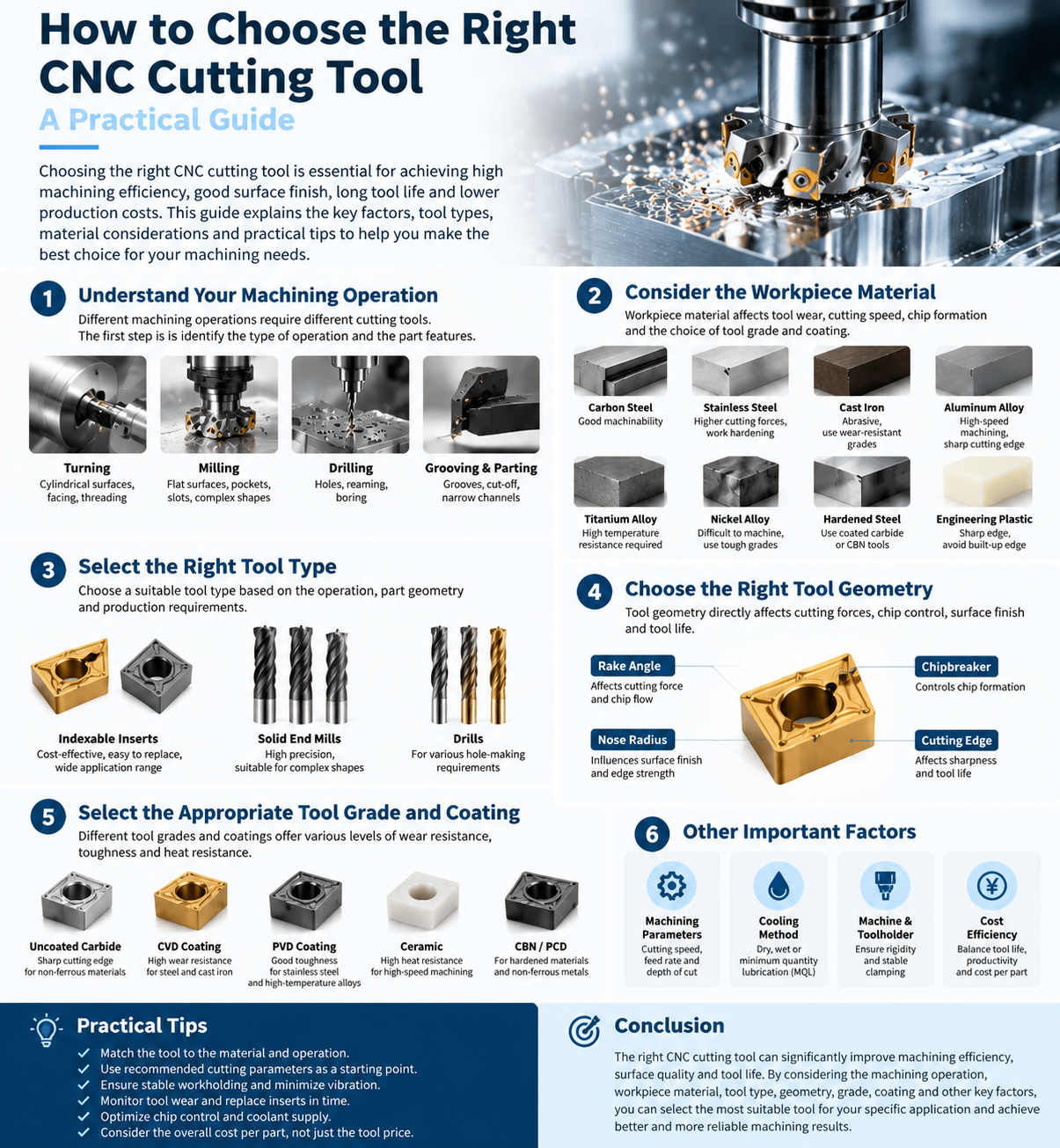
Why Is Choosing the Right CNC Cutting Tool Important?
CNC cutting tools directly affect machining accuracy, productivity, tool life, and manufacturing costs. Even a high-performance machine may deliver poor results if the cutting tool is unsuitable for the material or operation.
The correct tool should match the workpiece material, machining operation, machine capability, cutting conditions, and required surface quality. Selecting tools based on these factors helps manufacturers improve process stability and achieve more consistent production results.
Understand the Machining Operation
Start by identifying the machining operation. Different operations require different tool designs, cutting edges, geometries, and levels of rigidity.
Turning
Turning tools are used to machine external and internal cylindrical surfaces, faces, shoulders, and profiles. Select an insert shape, nose radius, and chipbreaker suited to the workpiece and cutting conditions.
Milling
Milling cutters remove material using rotating cutting edges. Consider cutter diameter, tooth count, insert design, engagement, and the rigidity of the machine setup.
Drilling
Drilling tools create holes in solid materials. Tool selection depends on hole diameter, depth, tolerance, material, chip evacuation, and coolant delivery.
Grooving and Threading
Grooving and threading tools require suitable edge geometry, width or thread profile, toolholder rigidity, and reliable chip control for accurate results.
Before choosing a tool, define whether the job involves roughing, semi-finishing, finishing, profiling, boring, parting, or threading. Roughing generally prioritizes material removal and stability, while finishing places greater emphasis on accuracy and surface quality.
Consider the Workpiece Material
Workpiece material is one of the most important factors in cutting tool selection. Hardness, toughness, abrasiveness, thermal conductivity, and work-hardening behavior all influence the cutting edge and tool life.
| Workpiece Material | Typical Challenges | Selection Considerations |
|---|---|---|
| Carbon and alloy steel | Heat, wear, and built-up edge | Suitable carbide grade, chipbreaker, and application-specific coating |
| Stainless steel | Work hardening, heat, and long chips | Tough cutting edge, positive geometry where appropriate, and effective chip control |
| Cast iron | Abrasive wear and brittle chips | Wear-resistant grade and edge strength suited to continuous or interrupted cutting |
| Aluminum alloys | Built-up edge and chip adhesion | Sharp edges, suitable rake angles, and effective chip evacuation |
| Hardened steel | High cutting forces and heat | Grade and geometry designed for hardened materials; consider the required finish |
| Titanium and heat-resistant alloys | High heat concentration and difficult cutting | Application-specific tool grades, controlled cutting conditions, and suitable coolant strategy |
Select the Right Cutting Tool Type
Once the operation and workpiece material are known, choose the appropriate tool family. The tool must support the required operation while providing sufficient rigidity and access to the cutting area.
Turning Inserts
Indexable turning inserts are commonly used for external turning, facing, profiling, and internal turning. Match the insert shape, clearance angle, nose radius, and chipbreaker to the application.
Milling Inserts and Cutters
Select the cutter style and insert geometry based on shoulder milling, face milling, slotting, ramping, or other milling requirements. Consider cutter engagement and the available spindle power.
Drills and Boring Tools
Hole-making tools should meet the required diameter, depth, straightness, and tolerance. Reliable chip evacuation becomes increasingly important in deeper holes.
Threading and Grooving Tools
Match the insert profile to the thread standard or groove dimensions. Check the toolholder clearance, cutting direction, and chip-control requirements.
Choose the Right Tool Geometry
Cutting geometry affects cutting forces, heat generation, chip formation, surface finish, and edge strength. A geometry that performs well in one operation may not be suitable for another.
Insert Shape and Approach Angle
Stronger insert shapes can be useful in demanding roughing applications, while sharper or more accessible shapes may be better for profiling and finishing. The choice must also account for workpiece contours, tool access, and cutting direction.
Nose Radius
A larger nose radius can improve surface finish and distribute cutting loads, but it may increase cutting forces and vibration under less rigid conditions. A smaller radius can help with profiling and reduce radial forces in some applications, but may reduce edge strength.
Chipbreaker Design
Chipbreakers control chip shape and direction. Roughing chipbreakers are often designed to handle heavier feeds and larger chip loads, while finishing chipbreakers are designed for lighter cuts. Select a chipbreaker suited to the actual feed, depth of cut, and material.
Select the Appropriate Tool Grade and Coating
Cutting tool grades are designed to balance wear resistance, toughness, and thermal performance. Coatings can improve resistance to wear, heat, and material adhesion when matched correctly to the application.
Carbide Grades
Cemented carbide is widely used in CNC machining because it provides a useful balance of hardness, wear resistance, and toughness. Different grades are optimized for different workpiece materials and cutting conditions.
Tool Coatings
Coatings such as TiN, TiCN, TiAlN, and AlTiN may provide different combinations of wear resistance, oxidation resistance, and thermal performance. Suitability depends on the coating formulation and application.
Cutting Edge Toughness
Interrupted cuts, unstable setups, and heavy roughing can require a tougher grade or stronger edge preparation to reduce chipping and premature tool failure.
Wear Resistance
Stable, continuous cuts may allow the use of grades emphasizing wear resistance. The final choice should account for cutting speed, temperature, material, and expected failure mode.
Avoid assuming that a harder grade or a more advanced coating is always better. The correct choice balances tool life, productivity, process reliability, and total machining cost.
Check Cutting Parameters and Machine Setup
Even the right cutting tool can perform poorly if the cutting parameters or machine setup are unsuitable. Review the following factors before starting production.
- Cutting speed: Match the speed to the tool grade, workpiece material, operation, and manufacturer's recommendations.
- Feed rate: Choose a feed that supports chip formation, productivity, and the required surface finish.
- Depth of cut: Ensure that the selected insert and toolholder can handle the planned material removal and cutting forces.
- Tool overhang: Minimize unnecessary overhang to improve rigidity and reduce vibration.
- Toolholder and clamping: Check runout, clamping security, holder compatibility, and machine condition.
- Coolant and chip evacuation: Use a suitable coolant strategy where applicable and ensure chips can leave the cutting zone safely and effectively.
When changing tools, adjust cutting conditions gradually and monitor the results. Follow the toolmaker's guidance and the machine manufacturer's safety requirements.
Balance Tool Life, Productivity, and Cost
The lowest-priced cutting tool is not necessarily the most economical choice. A tool that lasts longer, supports higher productivity, or reduces rejected parts may provide a lower overall cost per component.
Tool Life
Track tool life under consistent machining conditions. Frequent edge changes, unexpected breakage, and unstable wear can increase downtime and operating costs.
Productivity
Evaluate cycle time, material removal rate, setup time, and tool changes. Higher cutting speeds are only useful when the process remains stable and meets quality targets.
Part Quality
Consider dimensional accuracy, surface finish, burr formation, and consistency across production batches. Tool changes should not compromise part quality.
Total Cost
Include insert or tool cost, tool changes, machine downtime, labor, scrap, and inspection when comparing different tooling solutions.
Common CNC Cutting Tool Selection Mistakes
- Ignoring the workpiece material: A tool grade suitable for steel may not perform well when machining aluminum, stainless steel, or heat-resistant alloys.
- Using the wrong geometry: An unsuitable insert shape or chipbreaker can cause poor chip control, vibration, and premature wear.
- Overlooking machine rigidity: Aggressive cutting conditions can cause chatter or tool failure when the setup is not sufficiently rigid.
- Changing several variables at once: Changing the tool, speed, feed, and depth of cut together makes it difficult to identify the cause of improvement or failure.
- Choosing only by price: A lower purchase price may be offset by shorter tool life, slower cycle times, or increased scrap.
- Ignoring manufacturer guidance: Recommended cutting ranges and application notes provide a valuable starting point for safe process optimization.
A Practical CNC Cutting Tool Selection Checklist
Before ordering a cutting tool or starting a new machining job, review this checklist to confirm that the main application requirements have been considered.
Before Selecting Your Tool
- Identify the exact workpiece material and hardness.
- Define the operation: turning, milling, drilling, threading, or grooving.
- Determine whether the process is roughing, semi-finishing, or finishing.
- Confirm the required dimensions, tolerances, and surface finish.
- Choose a suitable tool type, geometry, and chipbreaker.
- Match the tool grade and coating to the application.
- Check machine power, spindle capability, and setup rigidity.
- Review cutting speed, feed rate, depth of cut, and coolant strategy.
- Evaluate tool life, productivity, and total cost per part.
- Validate the tool under actual production conditions.
Conclusion
Choosing the right CNC cutting tool requires a clear understanding of the workpiece material, machining operation, tool geometry, grade, coating, and cutting conditions. The best solution is the one that delivers reliable performance, consistent quality, and an appropriate balance between productivity and total manufacturing cost.
By evaluating these factors systematically and validating the results in production, manufacturers can reduce unnecessary tool changes, improve machining stability, and make better tooling decisions.
Looking for the Right CNC Cutting Tool?
Vellacho provides CNC cutting tool solutions for demanding machining applications. Share your workpiece material, machining operation, and production requirements with our team to discuss a suitable tooling solution.
Get a Quote